
Seven miles from the truck, the rear wheel folded up
Sponsorship disclosure: none. This trip was not sponsored. No manufacturer supplied equipment for it or had any knowledge of, or input into, this account.
Here's the honest version.
I rode out to two pieces of infrastructure in the South Florida wetlands. One was a derelict site whose original utility feeds collapsed years ago and never came back. The other was a water control structure and its monitoring station.
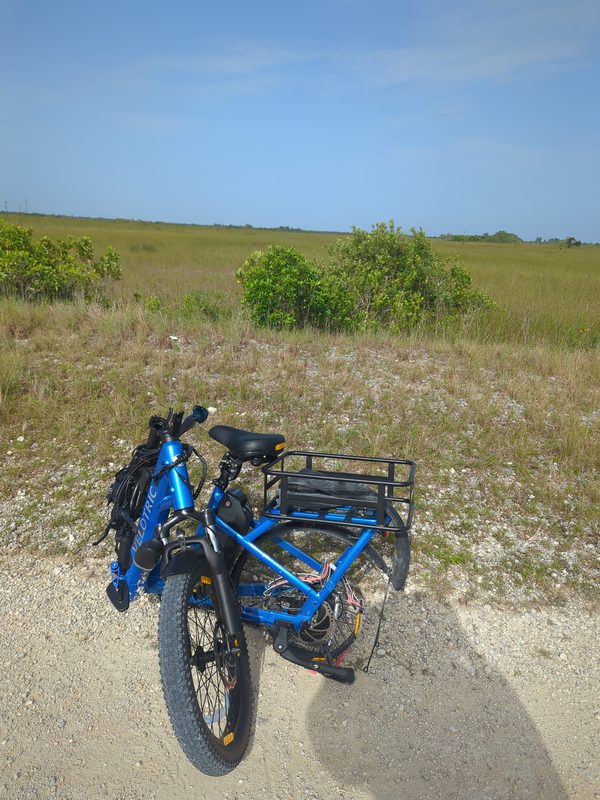
Neither is reachable by vehicle. That's the whole point. It's why I was on an e-bike, and it's why I was documenting the trip in the first place.
I got the documentation I went for. I also destroyed a bike, ran out of water, and walked the last couple of miles out of the Everglades in July with my gear on my back.
What failed
Leaving the first site, the rear tire went flat. No sealant, no insert, no way to reliably re-inflate in the field.
I kept riding on it. That was my decision, and it's the one that mattered.
A flat fat tire under cargo load on limerock means the rim is carrying the load directly against rock. Spoke tension goes. And on a rear-hub-motor bike, every bit of drive torque travels from the motor shell out through the spokes to the rim — so once that wheel de-tensioned, the motor kept winding it up until it collapsed inward on itself. Spokes in a spiral. Rim folded. The disc rotor, for what it's worth, came out fine.
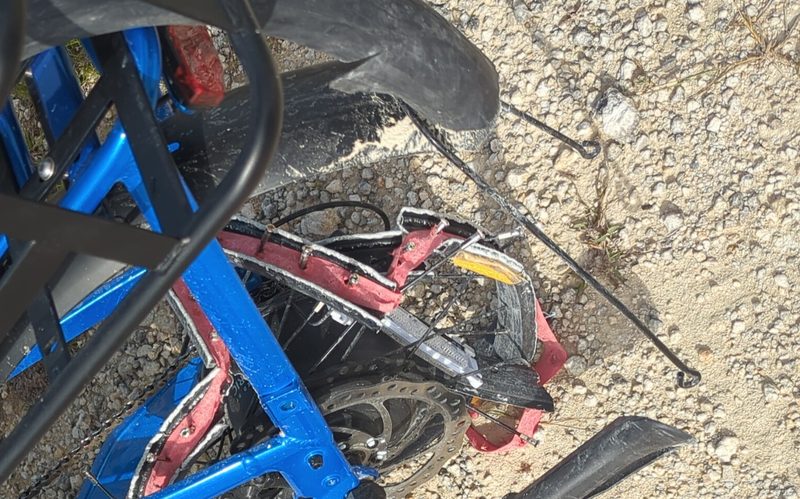
The bike had under 50 miles on it. This was its second job.
What I got wrong
I want to be precise about this, because it would be easy to make this a story about a bad bike.
The flat was the root cause. I could have prevented it with a $15 bottle of sealant. The wheel collapse was the consequence — and I caused it by choosing to ride out on a flat rather than stopping. A cargo platform that folds a wheel during a limp-out is a real engineering question, and I intend to ask it. But I put that wheel in the position to fail.
The gear I'd blame least is the gear that worked — the cooler did its job. The planning is what didn't: I didn't carry enough water and ran out five miles out. It got close to a heat emergency — close enough that I was weighing whether to use canal water to cool down.
What I didn't have
- Satellite comms. None. Cell coverage ran out partway. I broke down seven miles from the truck, out of contact, in July heat, and self-rescued on foot. That is the one on this list that could have turned into something worse than an inconvenience, and it's the one I'm fixing first.
- Tire sealant or an insert. The cheapest item here, and the root cause of everything else.
- A field repair kit that could actually finish the job. I got a partial repair — with help from a stranger who happened to be out there fishing, and who I'd very much like to buy a beer. It bought a few more miles. It didn't get me home.
- Enough water. The shortfall that nearly turned serious.
- Insect protection that works. The flies and mosquitoes chewed through a mask and a long-sleeve shirt. Not "were annoying." Chewed through.
- Power. No way to recharge anything, on a day where the phone is the safety system.
- Storage. I was rotating a single memory card between the drone and the 360 camera. I lost coverage I can't get back because I ran out of somewhere to put it.
Why this is published
Because the failure is the finding.
The reason I was out there on a bike is that these sites can't be reached any other way. Every utility, water management district, and DOT has assets like this — assets that get eyes on them less often than they should, because getting a person to them is genuinely hard. The gap between "someone should look at that" and "we can actually get someone there" is exactly the gap I fell into, seven miles out, pushing a folded wheel.
A trip where the access problem breaks my equipment is not a trip that undermines the point. It is the point.
Next time I'll be better equipped. That trip will be published too — including whatever doesn't work.
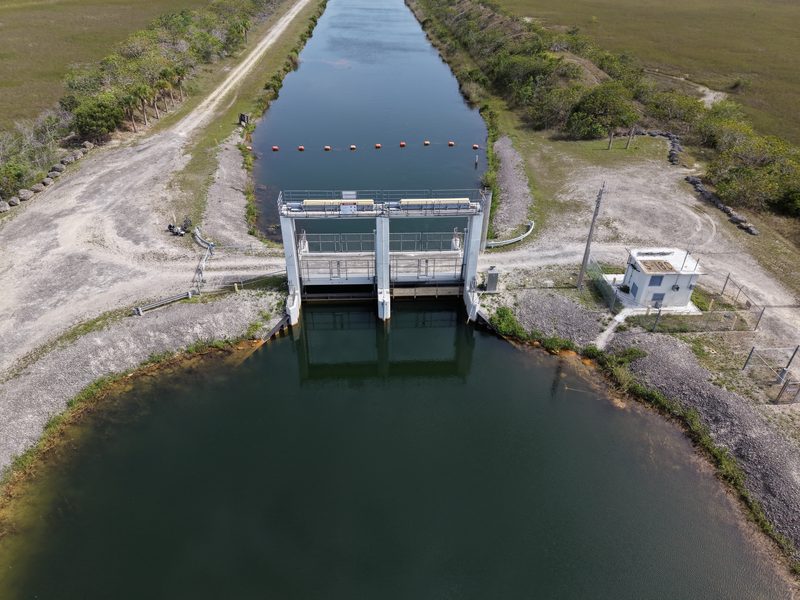
Limits of observation: this note records what I observed in the field on a single visit, from publicly accessible vantage points. It is not an engineering study of any structure or site, and no conclusion about any facility's state should be drawn from it. Locations are referenced generically.
This note is part of a documented field record: real equipment at real hard-to-reach sites, written under published editorial standards that commit to named disclosure and to reporting failure. Manufacturers who build equipment for this environment can reach me through the contact page.